On 27 June 2010 the FBI arrested ten people living ordinary American lives - married couples in Montclair, Yonkers, Arlington and Boston, a woman in Manhattan. Eleven days later all ten had pleaded guilty, given their real Russian names in court, and been sent to Russia in exchange for four people held there.
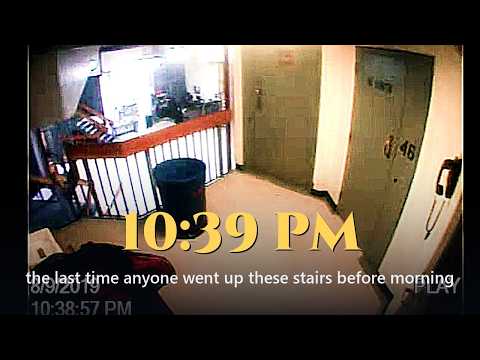
FBI surveillance video, no sound: Christopher Metsos' brush pass with official from Russian Mission in New York, 5/16/2004 Queens, New York. The sixteenth of May, two thousand four, ten to three in the afternoon. Two men carrying nearly identical orange bags meet halfway up the stairs of the Forest Hills train station, and each walks on with the other man's bag. The FBI was filming from more than one camera.
One of the men was a second secretary at Russia's mission to the United Nations. The other called himself Christopher Metsos. Hours later, in a restaurant in Sunnyside where the FBI had a microphone, he handed a package to a man who called himself Richard Murphy, and told him, "It is wonderful to be Santa Claus in May." The FBI called the case Ghost Stories. It watched for more than a decade.
In June twenty ten it arrested ten people, and eleven days later all ten had pleaded guilty and were being sent to Russia. In twenty eleven the Bureau released ten of its own surveillance videos. They have no sound. This film puts each one beside the sworn words of the FBI agents who said what the cameras were watching.
In two thousand nine, Moscow sent a message to Richard and Cynthia Murphy in Montclair, New Jersey. The FBI decrypted it. "You were sent to USA for long-term service trip. Your education, bank accounts, car, house, etcetera, all these serve one goal: fulfill your main mission, that is, to search and develop ties in policy making circles in US, and send intels to Center." The Russian foreign intelligence service, the S V R, called them illegals.
According to the complaint, they were trained in foreign languages, brush passes, short-wave radio, invisible writing, codes and ciphers, and a cover profession, then given a false identity, a legend, built on false documents. They were often placed in pairs, as married couples, and often had children together, which made the legend deeper. The FBI's searches found the seams. Richard Murphy's Philadelphia birth certificate carried a number the city has no record of.
In a safe deposit box in Cambridge, Massachusetts, were negatives of Tracey Foley as a young woman, on film made by a Soviet company. And a Canadian birth certificate for Donald Howard Heathfield, which was real. A newspaper death notice showed that the real Donald Heathfield was dead. FBI surveillance and evidence photographs, released with the Ghost Stories files.
Juan Lazaro said he was born in Uruguay. In two thousand two, a microphone in his house in Yonkers recorded him telling his wife about his childhood: "We moved to Siberia, as soon as the war started." This is how the FBI knew. Under court orders it put microphones in their homes, cameras in public places and in hotel rooms, and read their phone calls and e-mails. And it went inside.
Agents entered the Murphys' apartment in Hoboken in two thousand five, and a townhouse near Boston and an apartment in Seattle in two thousand six, photographed what they found, copied the computers, and left. The FBI Vault release of 31 October 2011: the Ghost Stories document files, declassified and redacted. FBI surveillance and evidence photographs, released with the Ghost Stories files.
In the Hoboken apartment agents photographed a piece of paper. It said alt, control, e, and a string of twenty-seven characters. That was the password to software the S V R used, which is not sold commercially. It hid encrypted text inside ordinary pictures on public websites.
Agents downloaded the pictures, and found well over a hundred messages. In the Boston townhouse, in October two thousand four, the microphone caught Tracey Foley asking her husband, "Can we attach two files containing messages or not? Let's say four pictures." Moscow also sent radiograms, coded bursts that sound like Morse code. In two thousand three the microphones in the Yonkers house picked up the irregular clicking of a coded radio transmission arriving, at least five times.
In one message the Murphys were told to make sure their radio equipment for receiving radiograms was in order, because Moscow planned to send a couple of tests. And Moscow paid. One report the Boston couple wrote for Center reads like a household budget: sixty-four thousand five hundred dollars received, rent, utilities, car lease, education, and four thousand nine hundred for their business, which they labelled, in brackets, cover. In Yonkers, in February two thousand three, the couple were recorded counting what the FBI believed were eight bags of ten thousand dollars.
Christopher Metsos did not live in the United States. He came in to pay people. In March two thousand two, at the same Sunnyside restaurant, the FBI recorded Richard Murphy complaining about his work, and Metsos telling him, "Well, I'm so happy I'm not your handler." When he left, he said, "there's forty," and something the recording did not catch, "black bag." The FBI believed it was forty thousand dollars. Now the orange bag.
After the stairs at Forest Hills, a GPS tracker the FBI had put on Metsos's car showed it driving north and stopping near Wurtsboro, in upstate New York. That autumn agents searched the spot. They found a brown beer bottle partly buried, and under five inches of dirt a package wrapped in duct tape. They photographed it, and put the dirt back.
A few weeks later Michael Zottoli and his wife Patricia Mills flew in from Seattle to meet Murphy. On the nineteenth of June they missed each other at Central Park. On the phone later that day Murphy said, "I was there at three." Zottoli said, "I was there at three o'clock, too." The next day they tried again, at Columbus Circle. FBI agents watched them meet by the subway entrance.
Neither was carrying anything, but Murphy had a backpack. They walked into Central Park together, and three minutes later came out separately, in different directions. Now Zottoli was carrying a red paper bag from a museum. FBI surveillance and evidence photographs, released with the Ghost Stories files.
The package stayed in the ground for two years. On the eighth of June, two thousand six, Zottoli and Mills went to the spot near Wurtsboro. The FBI had a camera there. This is Zottoli, digging, where the beer bottle had been, and taking out a small package.
From there they went to a hotel in Washington, where the FBI had a camera in the room. The video shows Zottoli with what looks like a full money belt, which he wore when they went out and hid under a pillow when they came back, and dividing money among several wallets.
In the autumn of two thousand eight the Murphys moved from Hoboken into a house in Montclair. The next summer they argued with Moscow about who owned it. Center wrote that the head of the S V R had personally decided Center would own the house, and let them live in it. The Murphys gave in.
"We'd like to assure you that we do remember what it is," they wrote, of their mission. Buying the house was a way "to do as the Romans do in a society that values home ownership. We didn't forget that the house was bought under fictitious names."
In April two thousand nine Center planned another handover. "Flash meeting with A, to pass him three hundred K. Half of it is for you. Another half is to be passed to young colleague.
Place: North White Plains train station, quiet and deserted on weekends. No surveillance cameras." The sixth of June, two thousand nine. The FBI had cameras on the station. A third secretary of the Russian mission comes down the stairs with a shopping bag.
Murphy goes up, holding out his backpack. The official drops the bag in. They do not speak, and pause only long enough to make the transfer. Afterwards the FBI preserved Moscow's reply.
"Flash meeting: well done, A, good job. Thank you. R and our tech people in New York didn't notice anything suspicious." The other half, the FBI believed, was for the young colleague, Michael Zottoli. The two men were to recognise each other with an exchange: "Excuse me, did we meet in Bangkok in April last year?" "I don't know about April, but I was in Thailand in May of that year." On the twenty-sixth of September, two thousand nine, in Brooklyn, the FBI was recording.
They walked, and sat on a bench in Fort Greene Park. After about ninety minutes Murphy gave Zottoli a bag and something smaller. Two days later the Murphys reported to Moscow: "Meeting with M was successful. A passed to M the card and one hundred fifty K."
In January twenty ten Moscow called Murphy home. He was to fly to Rome on his American passport and pick up an Irish one there, at a shop window near the San Giovanni subway station, from a man who would say, "Excuse me, could we have met in Malta in nineteen ninety-nine." Murphy was to answer, "Yes indeed, I was in La Valletta, but in two thousand," holding Time magazine, title outwards. In his left hand, it meant danger. He was also told to buy a laptop, with all necessary precautions: no preliminary order, pay cash, destroy receipts.
On the ninth of February agents watched him leave a store in Manhattan with a laptop box. He had paid cash and given his name as David Hiller. On the third of March he flew back from Rome with the same model of laptop, but a different serial number. The seventh of March, twenty ten.
Murphy meets Zottoli at a payphone in Brooklyn, and they sit in a coffee shop for an hour and fifty minutes. Agents inside hear Zottoli describe problems with the equipment he uses to talk to Moscow. Murphy says, "this should help," and, "they don't understand what we go through over here." Then he puts a plastic bag into Zottoli's duffel bag. Laptop, two flash drives, and nine thousand dollars, the Murphys told Moscow.
FBI surveillance and evidence photographs, released with the Ghost Stories files.
What was all of this for? Moscow sent the couples what it called info tasks. Before President Obama's visit to Russia in two thousand nine, it asked the Murphys for the views of named American officials on a new arms treaty, Afghanistan and Iran's nuclear program. The Boston couple reported a conversation with a government researcher working on small yield, high penetration nuclear warheads.
It was not always what Moscow wanted. In September two thousand two, in Yonkers, the microphone recorded Juan Lazaro: "They tell me that my information is of no value because I didn't provide any source." His wife, Vicky Pelaez: "Put down any politician from here!" Cynthia Murphy was told a government job was not an option, because her documents would not survive a background check. So she was pointed at people. A financier she worked with was checked in Center's database.
"He is clean. Of course he is very interesting target." She was asked to dig up personal data on students who applied for jobs at the C I A. And her reports on the gold market, Moscow told her, were very useful, and had gone to Russia's ministers of finance and economic development.
Not everyone in the network lived under a false name. Anna Chapman used her own. The FBI believed she spoke to Moscow on Wednesdays, without ever meeting anyone. She would open a laptop in a coffee shop or a bookstore, and a Russian official from the mission to the United Nations would pass nearby.
Agents carrying a wireless detector saw a private network appear, with just two computers on it. This is the twentieth of January, twenty ten, filmed by the FBI from several cameras at once. The FBI's caption calls it a department store, and points to page five of the complaint, which describes Chapman that day in a coffee shop near Forty-Seventh Street and Eighth Avenue, and a minivan the official had been seen driving passing the window. It happened on about ten Wednesdays.
On one, the seventh of April, the official seemed to notice he was being followed and went back to his office. That day the detector found only one computer, hers. On Saturday the twenty-sixth of June, twenty ten, a man phoned Chapman in Russian and said he needed to see her that day. He was an FBI undercover agent.
They met in a coffee shop in Manhattan, and he wore a recorder. The FBI filmed them. He said his name was Roman, and that he worked at the consulate. She said, "Everything is cool apart from connection." He gave her a passport in a false name, to hand to another illegal the next morning.
"Are you ready for this step?" "Shit, of course." Then she asked, "You're positive no one is watching?" An hour later agents watched her go into a pharmacy, a phone store, another pharmacy, and the phone store again. She threw away the bag. Inside was a customer agreement for a new phone, in the name Irine Kutsov, at ninety-nine Fake Street. The next morning, she did not come to the meeting.
The same Saturday, in Washington, a second undercover agent phoned Mikhail Semenko. "Could we have met in Beijing in two thousand four?" "Yes, we might have, but I believe it was in Harbin." On a park bench Semenko told him the Center guys had trained him, that his last session had worked, "I got mine," and that if something went down he would erase the hard drive. The agent gave him a folded newspaper with five thousand dollars inside, and a map to a spot under a bridge in a park in Arlington, Virginia, for the next morning between eleven and half past. The FBI put cameras near the bridge.
At eleven Semenko crosses it carrying a white bag. At six minutes past, he puts the newspaper in the drop site. At eleven fifty agents took the newspaper back out. The envelope was still inside, with the five thousand dollars.
That Sunday, the twenty-seventh of June, the FBI made the arrests. The Murphys in Montclair. Lazaro and Pelaez in Yonkers. Chapman in Manhattan.
Zottoli, Mills and Semenko in Arlington. Heathfield and Foley in Boston. The charge they all faced carried up to five years. Most also faced conspiracy to launder money, up to twenty.
Eleven days later, in Manhattan federal court, all ten pleaded guilty to one count, conspiring to act as agents of a foreign government without telling the Attorney General, and gave their real names. Richard and Cynthia Murphy were Vladimir and Lydia Guryev. Michael Zottoli and Patricia Mills were Mikhail Kutsik and Natalia Pereverzeva. Donald Heathfield and Tracey Foley were Andrey Bezrukov and Elena Vavilova.
Juan Lazaro was Mikhail Vasenkov. They were sent to Russia. In exchange, Russia agreed to release four people held there for alleged contact with Western intelligence. The FBI says the illegals never got their hands on any classified documents.
One of its agents put it this way: "No government does that without expecting a return on its investment." One person charged was never brought back. Christopher Metsos was arrested in Cyprus two days after the others, posted bail, and disappeared. The FBI still lists him as wanted, with ten aliases, a reward of up to fifty thousand dollars, and a note that he may have fled to Russia.



 Wonder Minute